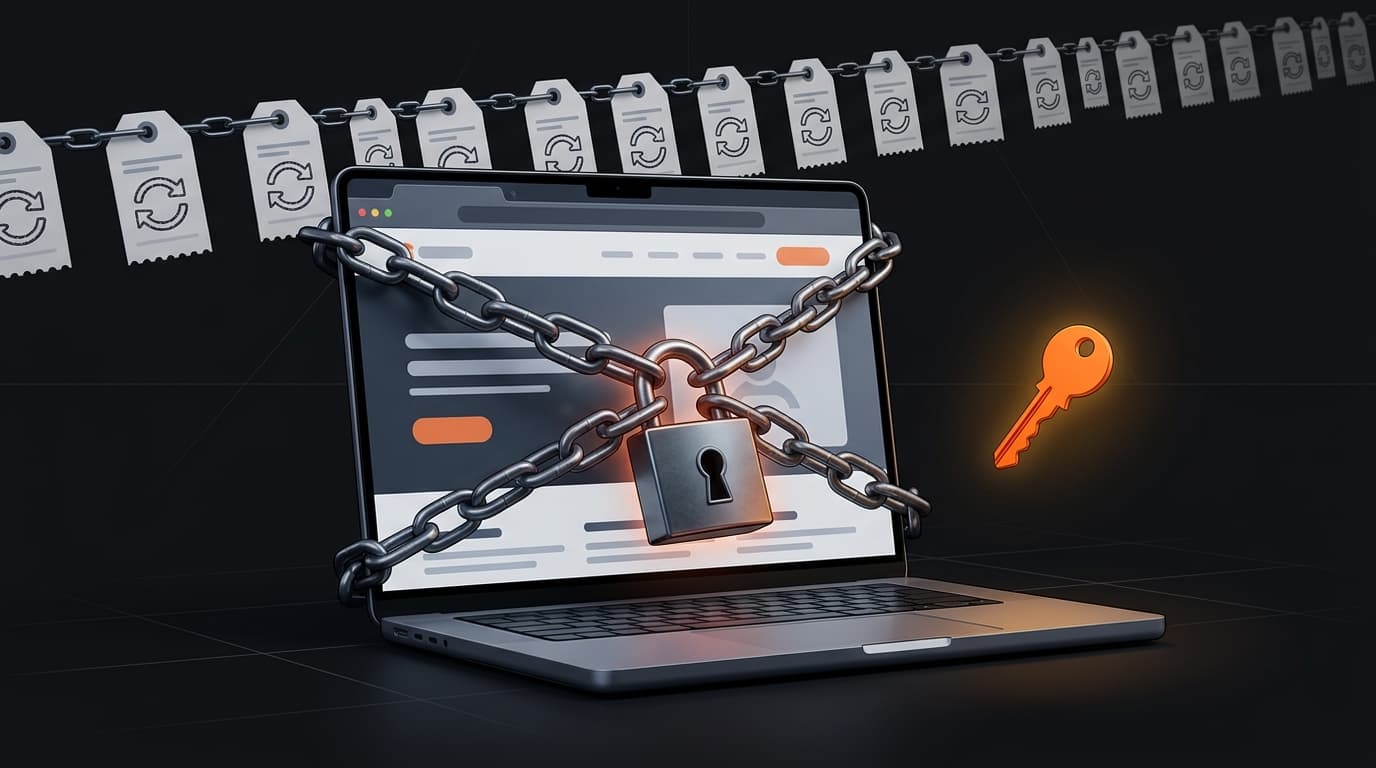
There's a question that matters more than "how much does a website cost?" — and almost nobody asks it before they sign.
Do I actually own this thing?
A huge number of contractors are paying $100, $200, even $300 a month for a website they will never own. They don't realize it, because nobody framed it as renting. It was framed as "your website, plus hosting and support, for one easy monthly payment." Sounds reasonable. It's a trap, and I want to walk you through exactly how it works so you never fall into it.
How the rental trap actually works
Here's the setup. A "marketer" or a small agency offers to build your site with little or no money down. The catch is a monthly fee — usually somewhere between $100 and $300 — that you pay for as long as you want the site to stay online.
Most of these are built inside an all-in-one marketing platform like GoHighLevel (GHL), Wix, Squarespace, or some proprietary builder the agency controls. The key detail: the site lives inside their account, on their platform, under their control. Not yours.
You're not buying a website. You're leasing space on someone else's system. And like any lease, the moment you stop paying, you're out — except with a website, you don't just lose the keys. You lose the whole house.
What happens the day you stop paying
This is the part nobody explains up front. Here's the reality when those monthly payments stop:
- Your site goes dark. Not "reduced features." Gone. Visitors get an error page or a parked domain. Anyone who Googles you finds nothing.
- Your leads stop, instantly. Every call, form, and quote request that came through that site dries up overnight.
- Your Google ranking evaporates. Search rankings are built on a live, consistent site. Take it offline and the ranking you spent months earning resets. Even if you rebuild later, you're starting from zero.
- You can't just "move it." This is the cruelest part — and it deserves its own section.
Why you can't take the site with you
When you own a website, leaving a host is simple: you export your files and your database and move them somewhere else. A normal, owned site is portable by design.
A rented site is built to be the opposite. Here's why you're stuck:
- The code isn't yours and isn't portable. Platforms like GHL don't hand you a clean website you can upload elsewhere. The site is assembled from their proprietary internal tools. There's no "download my website" button that gives you something another developer can actually use.
- They own the account. The site sits inside the agency's platform login. You often don't even have admin access — they do. You can't move what you can't reach.
- Your domain might be hostage too. In a lot of these setups, the agency registered or controls your domain name. Leave on bad terms and you can find yourself fighting to get back the web address with your own business name on it.
- Your content and design don't transfer. Even your copy, your photos, your layout — rebuilt inside their system — usually have to be redone from scratch somewhere else.
So when you decide to leave, you're not moving a website. You're abandoning one and starting over. They know this. It's the entire point. The friction of leaving is what keeps you paying.
The real lifetime cost of "just $200/month"
"$200 a month" sounds small next to a one-time price. That's the psychology the whole model relies on. So let's do the math nobody wants to do for you.
- 1 year: $2,400
- 3 years: $7,200
- 5 years: $12,000
- 10 years: $24,000
Twenty-four thousand dollars. For a website you still don't own at the end of it. If you stop paying in year ten, you're left with exactly what you had on day one: nothing.
And that's the cheap end. At $300/month, ten years is $36,000 — for a template-grade site that, as we covered in the difference between a $3,000 and a $500 website, probably doesn't rank or convert in the first place.
Compare that to the alternative: pay once, own it forever, host it for free. The rental model isn't a convenience. It's one of the most expensive ways to put a business online that exists.
"But the monthly fee covers hosting and support!"
This is the justification you'll hear, so let's address it honestly.
Hosting for a fast, well-built small-business website is genuinely cheap — often free, and almost never more than a few dollars a month. It does not cost $200/month. Nowhere close.
Support is real work and worth paying for when you actually need it — a redesign, a new page, a feature. But "support" in the rental model usually means access to a site you'd own anyway. You're paying a permanent monthly fee for occasional help you may rarely use. Pay for changes when you need changes. Don't rent your entire business presence to get them.
What ownership actually looks like
Owning your website is exactly what it sounds like, and it should be the default — not the premium upgrade:
- You pay once. No recurring fee hanging over you.
- The site is yours. The code, the content, the design — all of it. You can hand it to any developer on earth and they can work with it.
- You control the domain. It's registered in your name, in your account.
- You can leave anytime. And because you own it, "leaving" just means pointing it at a new host. The site comes with you, intact, rankings and all.
- Hosting is free, forever. No monthly ransom to keep your own business online.
That last point is the whole philosophy behind how we price things at Develanet — one flat fee, you own it outright, free hosting for life. No lease. No lock-in. No "what happens if I stop paying," because there's nothing to stop paying.
The one question to ask before you sign anything
Before you hand any money to anyone for a website, ask them this, and get the answer in writing:
"If I stop paying you, do I keep a fully functional website that I can move to another host? And do I own my domain?"
If the answer is yes — great, you're buying, not renting. If the answer is no, or it gets vague and complicated, you now know exactly what's going on. You're being offered a lease on your own front door.
Don't rent your website. Own it. Here's what that looks like — and if you've got questions about getting out of a rental setup you're already stuck in, reach out. It's usually more escapable than the people collecting your monthly fee want you to believe.
Ready for a website that actually gets calls?
One flat fee. No monthly costs. Free hosting forever.
See Pricing